Thursday, March 06, 2008

"No One Likes a Bully: The IIPA and Canada" UPDATE

William Patry hits one out of the ballpark here: "No One Likes a Bully: The IIPA and Canada"

This blog article blows my mind. Its not a must read; that is trite. How about a civic duty?

It exposes in my opinion a clever corruption of the term "International" and lots of other clever corruptions.

For a company in battle for survival now with Microsoft, whether they know it or not, I personally expect no less to come from him.

In fact, I expect much more from him, not just in his preferred field of copyright but to the roots of what is copyright law, in its framing a competitive marketplace for intellectual goods and services, that serves best the public interest. That may in a US context, require examination of the Sherman Act and how the Copyright Act must fit with that Act and answer also to the public interest in that particular law, its twin evolution and history, against industry trusts and harmful monopoly power. Copyright is after all a grant of monopoly by the people to the creator and the holders of those copyrights, which may not be the creative, fuzzy and warm artists often projected as the author, but rather people who are instead servants subject to the power of the creator and copyright holder, like the members of the Writers Guild of America and most members of ACTRA here at home.

This is not to tarnish him or his views in any way, but it is a wake call to all consumers really, that I read in the undertones, of what is at the root of the problem: the corruption he exposes of process, word and deeds (our government appeared ready to walk into a "trap," that Industry Minister Prentice has fended off to date, possibly to his credit, a story in the making perhaps?).

Another such wake up call is Professor Lawrence Lessig's new calling "Corruption". No more copyright issues, he has moved on, perhaps identifying his best use of his considerable human capital as well as his followers perhaps in the realization that the copyright law he loves, is but a tool of anti-competitive manipulation in context of industrial property and competition laws.

There is no other person like Lessig, in energizing an issue and in being in fearless pursuit of the truth, the true scholar's passion and obsession. Smell and all, at the end of 10 years of study, just as the Creative Commons is very well known, so may be the awareness of corruption both on those who participate in it and those who watch it occur, in complicity.

This blogger will say a small prayer tonight, optimistic that the truth will win out. That once corruption is brought to fuller American awareness, that America will properly deal with it.

We in Canada, whom William Patry assists greatly, in filling in much of our "broken news" in his post, owe Mr Patry a greater debt of gratitude, not for this exposure of the process we may have succumbed to and its evils, but for what he exposed for his own countrymen to fit into their reality and figure out for themselves, where his country has gone wrong.

Certainly, there will be battles, where spin and FUD get plied, where "success should not be penalized", etc, etc, etc. Its old news and old angles to come. Screaming billionaires making monopoly profits are just somehow not that sincere in protestations, where the games played evolved into rules beyond any recognizable public interest. The unscientific v. the scientific. The media "mashing of the issue" v. the truth that the MSM is an issue itself, if it cannot get the answers for, and by the people the MSM claims to serve.

We hope the people win this one. The cold Hell otherwise is also a fitting and deserving end, if they lose. I certainly do not want to reside there.

UPDATE:
Ariel Katz, a very thought provoking law professor at the UofT who teaches competition law and intellectual property, and who is the Innovation Chair in Electronic Commerce, has just released an interesting paper that needs a full examination. Its available here, entitled "Making Sense of Nonsense: Intellectual Property, Anti-trust, and Market Power." The policy twins in industrial property, competition and intellectual property (patent, trademark, copyright, design, trade secret law), clash.

The legal people may have their debate:
what about the "people" and their representatives?


This is the type of provocation that might tip to a larger debate. This professor has worked the issue hard as to whether copyright collectives should exist anymore for example. Always an interesting challenging point of view. This one must have some wet spots but harder spots too, with great learning potential. It may address what challenges William Patry in this blog post must surely have to address by day, particularly as a monopolist in one market is about to move to compete directly with his own firm. Does Professor Katz deal with the Sherman Act / Clayton Act with this situation or it is a non-obvious extension to a future article as a monopolist may again embrace and extend its market? Stay tuned after this law and economics article gets its due digest.

Wednesday, March 05, 2008

Rick Mercer: From the Desk of Stephen Harper

Rick Mercer: From the Desk of Stephen Harper

Is parody legal in Canada? Watch out Rick Mercer.

This is a "beauty," eh?

Update 1:

But is this comedy or a comic reality?

No tax guidelines, no worries, right?


The Toronto Star's Martin Knelman on the to be tabled Guidelines that took 8 years to make ... that were evidently shown to someone to start this chain of what I would call an unintended exposure, that now evidently do not exist.

Update 2:

The Globe and Mail story that appears to have the scoop on the Guidelines states they exist.

Tories plan to withhold funding for 'offensive' productions

GAYLE MACDONALD

From Thursday's Globe and Mail

"The Conservative government has drafted guidelines that would allow it to pull financial aid for any film or television show that it deems offensive or not in the public's best interest – even if government agencies have invested in them."

...

What started this? Would you believe Paul and Karla.

News is that this was put in by the Liberals to block funding of a film on Karla Homolka, that itself might have been an over reaction. Like should we censor sh-t like that? I would not pay for it but maybe there is something there in a biopic that the media and court tales missed? I have no sympathy for her what so ever but it is a story that blanketed the media for what 6 months? I think if I recall correctly the families lawyer, Tim Danson, acting pro-bono, worked this line against the exploitation of the victims in any film. Maybe the right law instead should have been like any proceeds due a crook from crook tales should be property of the state, i..e. effective proceeds of crime legislation. That in itself raises all kind of issues like a victim's right to privacy i.e. they are not a public figure and the use of their private image, etc. would be a violation of their privacy rights, subject to something along the lines of defamation and infringement of their right to exploit their own image i.e. right's normally obtained in the movie biz obtained before filming to prevent this kind of action. The US law might be helpful here. So might an extension to cover a murder victim, who has no estate interest. Why not give that estate an interest? You want to exploit the murder of my child? I will own you unless you pay me x,y,z. or no money will make up for the horror of this event to my life and your money is not worth anything to me or what I could use it for in their honour i.e. forget about it. The victim should have a choice. Not censorship. A private legal remedy fixed to an appropriate statute could solve it all.

Strange Bedfellows: Liberals and Conservatives, Film Industry Consultations in 2003, Bill C-10

Government Announces Changes to the Canadian Film or Video Production Tax Credit November 14, 2003

That is right 2003.

Someone on Facebook pointed to this press release that indicated the film industry was consulted on these changes.

Today’s proposal results from ongoing consultations with all sectors of the film industry, which were undertaken by the Departments of Finance and Canadian Heritage following Budget 2000.
Liberal Ministers Copps and Manley issued this.

Ok ... the story gets interesting ... the press release makes no reference to the issue before the public now. It does however refer to the Income Tax Act amendments:

Amendments to the Income Tax Act relating to Films and Video Productions


The nasty 13 words "public financial support of the production would not be contrary to public policy" are disclosed twice, connected with the notion of "Guidelines."

"The Minister of Canadian Heritage shall issue guidelines respecting the circumstances under which the conditions in paragraphs (a) and (b) of the definition of "Canadian film or video production certificate" in subsection (1) are satisfied. For greater certainty, these guidelines are not statutory instruments as defined in the Statutory Instruments Act."

A legitimate question arises: was the Film Industry consulted entirely on this? Secondly, were they competent to follow up on the press release and the hyper links from it, putting forth the Amendments also made known that date. The Amendments show "Guidelines" to come, and the critical "contrary to public policy."

With the legislation this old, and since "consultations" already have taken place, where are these Guidelines almost 5 years later? One would think they would be available by now.

It would seem the Conservatives have to tuck in the covers for the beddings the Liberals were going to put in place.

Oddly, today in the House, the Bloc Quebecois stuck up for Canadians interest everywhere by protecting the Quebec interest and so did the NDP. The Bloc moved a motion to amend C-10. The Liberals and Conservatives tied the knot again to defeat this amendment.

The Senate that erstwhile pesky institution that the founders of this country knew was needed, has evidently put pause to both the Liberal and Conservative plans to put in public policy guidelines on the Film Industry of Canada, potentially crippling it immeasurably.

Now being the critical lot I am, would not the Heritage committee also be clued in here, so the claim in the House of no notice, or the slipping in of an amendment, is quite questionable, particularly with the Liberal-Conservative concord on this measure and its age overall since its 2000 year origin.

UPDATE: The Liberals have seen the light and are going to support artistic freedom and expression and of course blame this on the Conservatives:

Liberals to Shed Light on Conservative Censorship Attempt

Wait until the Liberals wake up and see who put in the measure in the first place. They are entitled to now a broader review of what they were going to do. And they are the Loyal Opposition now giving them leeway. The Conservatives now appear to be in a stubborn contest to see who is most unelectable, a context they have a chance of winning bigtime in Quebec and Ontario. Its not always who you vote for that counts but who you vote against. Ask Danny boy, the A.B.C. - Anything But Conservatives - champion. Bet on the NDP getting a new level of invective cast their way in the months to come, cuz like it or not, they can come up the middle here. It might be Jack's election to lose while we vote ABC with no stomach for the Liberals still deserving evidently of being in the penalty box.

A Nascent Film Makers Point of View

David Germain's blog: Hey! Hey! Ho Ho! Bill C-10 has GOT TO GO!!

Tuesday, March 04, 2008

The Future of Reputation


The Future of Reputation by Daniel L. Solove, Yale University Press (2007)


This is an interesting US centric read, released on the net with CC licence. I personally have thought through some of these issues but more thinking never hurt anyone, as these issues become core issues of the Digital Age. With our copyright law up for reform (RSN) and it being one of my pet subjects, a law like that imposing property law concepts onto almost everything done on the Internet, has impact on many ordinary things. As some have said, Copyright has become sexy.

Such a framing legislation, can be "the" or "a" Digital Age 'Constitutional' document, giving and taking rights to and from people. This is a core Generation Y issue, that the youth appear to get, whereas the aging boomers, and those not so technologically plugged in, got surprised. No surprise now: copyright law matters to many more than just "professional" publishers and artists. Everyone can be an artist now (so you don't like my writing 'arts', Ctl "L" and swoop somewhere else ... for brain food! Sorry for the browser tip ... )

Here is the book's TOC:

Chapter 1. Introduction: When Poop Goes Primetime

PART I
RUMOR AND REPUTATION IN A DIGITAL WORLD

Chapter 2. How the Free Flow of Information Liberates and Constrains Us

Chapter 3. Gossip and the Virtues of Knowing Less

Chapter 4. Shaming and the Digital Scarlet Letter

PART II
PRIVACY, FREE SPEECH, AND THE LAW

Chapter 5. The Role of Law

Chapter 6. Free Speech, Anonymity, and Accountability

Chapter 7. Privacy in an Overexposed World

Chapter 8. Conclusion: The Future of Reputation

Notes & Index


In relation to "our" framework legislation, from the above come questions for us to consider from the experience of another country to these issues.

The intersection of privacy rights is subtle to copyright law and the interdiction of the Privacy Commissioner of Canada into the debate recently, indicates that there are more stakeholders than the organizations that use "Canadian" in them, that can represent companies that are foreign branch plant outfits, with the concern of "hiding" that nature while lobbying for preferred laws for their market access for their predominantly foreign authors and holders. You really need a score sheet to tell who is representing who, and the more light here shone on the situation the better, I believe.

Do you take the views of the Canadian Publishers' Council or the views of the Association of Canadian Publishers? Roy MacSkimming's book is an excellent read on this battle. Which one has members that appear entirely owned by foreigners with a branch plant executive? The story of the Canadian Recording Industry Association is more well known vs the Canadian Independent Record Production Association.

This is part of my "who own's who" theme running through my blog because I am 'born again' Canada first, cultural nationalist. I have to get over the label because I don't like labels. But that is what I am. Call me old fashioned but I prefer Canadian stories and Canadian efforts at artistic expression, deep, dark, puzzling, or even vulgar. For an anglophone, I love Quebec films with or without subtitles or formal translations. Every time I travel away and come home, there is no place like Canada to me. Dang CBC, CTV, Toronto Star, Globe and Mail, La Presse, Whig Standard, sometimes. But its that news and our stories that matter most to me. So our art and the opportunities that that our small sectors matters very much to me, that they get heard and they get a fair shot, including a handout if its needed to jump start a strong domestically controlled cultural industry. If they don't get it here, where?

I can of course go on, at how the US developed their cultural industries, without any respect to the international rules we were following, till it was to their advantage, with the sly pervasive lobbying that has existed from the branch plant owners and foreign interests that most governments were made aware of to know exactly what was going on. We are a people liberal in listening to foreigners and some of us may get fooled some of the time. The Toronto Star appeared to take the bite here in my opinion but the Star can bite back at any time. Especially if fooled.

At this time, its better to leave this post with one thought:

Canada's Cultural Media:
if its not made here, where?

The Film Artists Speak Up Prominently to C-10

So much for my trouble with finding the words ...

"I think it flies in the face of what we should be looking towards as a civilized nation in terms of supporting our artists, supporting unique visions. Making films that challenge, that provoke, that create discussion. Sex and violence are part of the world we live, in so they will be represented by artists. It's terrifying and I'm just hoping that the outcry will be loud and persistent enough that it will go away forever."
-Sarah Polley

"What's happening tonight — which is about celebrating Canadian film — I feel I can't go on without bringing up Bill C-10. [If passed], a very small group of government bureaucrats [will have the] the power to censor Canadian film and television artists by threatening to take away vital government funding. So in other words, censorship … is trying to make a comeback. I don't know about you, but that doesn't sound Canadian to me.""
-Sandra Oh

"C-10 hasn't made it through the Senate yet."
-Senator (General) Romeo Dallaire

“Eastern Promises is a screenplay that is chock full of the powerful, frank, honest, original scenes. Just the kind that if some barbarians have their way, is no longer going to be permissible in Canadian cinema.”
-Robert Lantos


And the headline from the Globe and Mail about the Missing Minister Verner:

"Minister snubs Genies amid film flap"

And just in case you thought the the Facebook Fair Copyright for Canada group grew fast, check out the 17,500 in 5 days, and pass it along: the Facebook "Keep your censoring hands off of Canadian film and TV! No to Bill C-10!"


Monday, March 03, 2008

Film Funding Furour and the CBC

CBC News: Sunday

After watching a segment on TV called "Film Funding Furour," I feel like a free person just arbitrarily detained. I feel anger and horror. Furour is a lite expression of the rage I feel, thinking of those who died fighting for the freedom represented by the film maker v. those "believers" who were likely conscientious objectors, worse "uninvolved," or even worse, in with the book burners, that Canada fought against.

I cannot say more. I am too upset.

Read: John Degen's view before this show. Julianna Yau picks up on the story brewing, and has a great link to the views breaking out getting greater publicity. See some of the comments to the show if you missed this "debate." Many are disgusting to me.

Personally I hope every filmmaker operating in Canada, foreign or domestic, puts their camera down. Shut it all down. This is pathetic behavior in a "freedom" based democracy, and should be over exposed.

Should TV show producers be concerned? I would guess after the first group is beat up, you will be next.

Here is the picture in my head:

"First they came…" is a poem attributed to Pastor Martin Niemöller (1892–1984) about the inactivity of German intellectuals following the Nazi rise to power and the purging of their chosen targets, group after group.


Update: Professor Sam Trosow digs into the story:

Bill C-10 Triggers Censorship Concerns
samtrosow.ca - Monday, 03 March 2008

What Is Net Neutrality, Anyway? - Column by PC Magazine's John C. Dvorak

What Is Net Neutrality, Anyway?

John Dvorak of PC Magazine knows all about the technology and the players, since his pet love outside of personal computing, is telecommunications.

This is part of closing argument:

"Net neutrality does not keep the ISPs from selling me a 10-megabit-per-second connection at a higher price than a 1-Mbps connection. It does not kill competition. What it does is allow me to get what I want at the speed that I paid for rather than have some socialists née corporate apparatchiks (I can pull the socialist stunt, too) back at the Kremlin/HQ deciding that I will get a Google feed at half the speed of a Microsoft Live feed when I do a search. "

Very quick and to many points.

Sunday, February 24, 2008

Epilogue: Publishers v. Writers, 2-1. Prospects for Tie?

Epilogue

In Part 1 and Part 2 of my blogging on this report, I covered the presentation of the report, and the facts as we could discern them from the Friedland report in context of the Boards comments pre, during, and post that report.

To this analysis in Part 1, we found some rather unusual "properties" engaged in this Report as released by Access Copyright, in context of its websites' TOS. Thankfully we discovered two new things since that writing.

The “Friedland report”, without the Board's "spin", was to be a public document as a condition of the engagement per the Writer's Union, a constituent member of the Canadian "CCC," Creators Copyright Coalition. This has an obvious conclusion reinforcing the recommendation made for independent Directors by Professor Friedland that I focus in on in Part 3 on its own.

The second discovery was the “clean” copy of the report made available by Christopher Moore, a writer of some rather interesting books on Canada's history, published columns drawing extensively from historical facts, and a former Board member of Access Copyright. This DRM and comment free version enabled a quieter read and thought as to what the Fact Finder found and recommended. Comparatively, Access Copyright added new information not available elsewhere but still failed to disclose information that we had to derive in Part 2 from their document and public information.

A Burning Question: The Views on Reprography v. Reproduction

One other item that seems of burning contention from reading both reports, is the differing views on reprography v. reproduction, in the case of the missing terms in a publishing contract over who deserves a share from any reprography expressly. This presents itself in the core arguments of accounting for a “contract override” v. just a ‘clean’ straight split on the royalties collected by the collective for each of its two distinct groups of member categories. This even ‘split’ is what most collectives appear to do in existing for the mutual benefit of members, recognizing the claim on their behalf, to the “micro” use of rights otherwise either unenforceable or uncollectible, at present, that can in argument to date, can be claimed on a “macro” scale to exist.

Professor Friedland in his report concluded as if prescient that a grave misinterpretation of a “reprographic right” could be present, to a claim of rights that were not expressly provided for in contracts between writer and publisher, by the publisher. The Board did obtain a legal opinion on this, but this may not have directly addressed what the writers could claim in light of the Heather Robertson Supreme Court of Canada case (Ed. note: linked here is a rather unusual 'translation' of the case by Christopher Moore, a provocative read IMHO) versus what the publishers had already claimed. That case illustrated an over claim of copyright by a Publisher where the right of use was found to infringe the original authors retained interests as it was not explicitly conveyed in terms of an agreed compilation of a work v. the distinct de-compiled use of a work the publisher was alleged to claim. All told, this is a major difference of opinion not to be glossed over, core to the collective’s reason for being, and likely its future which I could express a longer term doubt over.

As I understand “reprography” to be the making of private physical copies of published works in print form, it certainly engages a different set of rights than merely the reproduction right, the right to make copies of a work in any material form, at subsection 3(1) of the Copyright Act [Ed. note: there is no "interpretation" to "reprography" in the Copyright Act or the Regulations; it is referred to as "reprographic reproduction."]

Who is right? Here Comes Da Judge

I lean to the Professor’s views as he provides caution in context of the current interpretation of the Copyright Act, expressing reasonable doubts.

The other side appears to state the matter in conclusive tones in contrast, such of the type that usually sets in motion a change in venue to a Court of Law for any further progression.

To me, I *sigh* thinking this latter view as very uphill by ignoring the apparent flow of rights involved, absent the necessary rights to establish a narrow case of infringement resting on “reproduction” alone, making that view unpersuasive, and also ultimately divisive.

To be fair, the legal opinion has only been referred to, rather than released by the Board. However it was not an unknown view to the law Professor, who admitted the consultation of his colleagues, not known to be the lightest of thinkers without resources on such matters. It is in fact a necessary view he had to overcome, to support the whole idea of the 50/50 ‘split’ between the members group on this issue that was rejected. This has great traction and history with many in the publishing field but so did the failing position of the publishers of the Globe & Mail against the views of Ms. Robertson.

I believe that the publication right has to be considered and that it is in the combination of rights to make the “reprographic” case in first instance, to collect upon versus merely a “reproduction” right infringement. In my view, if the view of Access Copyright were correct, there would be no need for a publication right expressed, in full context of Canadian copyright law. The US concept of a distinct distribution right has no similarity in Canadian law, and yet this lack of intrusion appears to confuse many in Canada, in my opinion, as they fail to read past a specific right to the entire section applicable to the right, including its contextual rights, and the authorization right. With the divisible nature of rights, a package of rights is ordinarily required to do business, particularly so the publication right, the right to make public a work.

Having the right to make a reproduction is valuable in itself, without the necessary condition to publish or attach such a right casually to publish those copies, or in U.S. terms "copying" is distinct from “distribution.” In the case of reprography, in my view it would be impossible to have reprography occurring without the use of the publication right. Without a publication right coincidently applying, such a reproduction would be not be of a work made public and be rather a private work which has its own reproduction right. This is not something that Access Copyright apparently has a right to collect over.

In other words, to sue for infringement of copyright over non-commercial photocopying of a printed work, in the case of a published work, you would have to demonstrate a) you still own the right to make it public, b) the act of reproduction of such published work occurred, and c) it was unauthorized. Lose on one and you seem to be quite out of luck.

That is the bundle of rights analysis. But does that bundle view, where clearly the publishers should have acquired the separate rights, include what could be specifically expressed in a contract as "reprographic reproduction" in a direct reference to the Copyright Act?

Further, is "reprographic reproduction" that lacks "interpretation" from the Copyright Act itself, a right itself as it appears granted in reference to a use? Or is it an expression implicit in a construction of a bundle of rights elsewhere provided for?

To me, Canadian copyright scholars would have a picnic here, and this is the point: there is reasonable doubt from the "Academics." The practitioners say no. The Canadian courts have yet to consider it.

Closer to Home

For a closer to home example, think of a photograph you take. You own the picture, not the subject of the picture. You may infringe the rights of the subject so cautiously or not, you snap away. You take the undeveloped film or send the digital form to Black's, and Blacks asks from you before developing your film and/or printing your paper prints, i.e. producing or making copies of your work, if you have copyright to order such work and make such copies, and may ask you to agree in the 8,000+ word TOS, to holding it harmless in doing any of the above. It does not ask if you have publication rights. In person there may be something stuck under glass or on the wall or on the receipt of the order, saying the same thing to get itself out of being sued as the “licensed” manufacturer of your claimed work, where you may not own all the rights to produce or reproduce it.

If your photos are good, and someone wants to buy them for publication, they obtain that right, and as part of that deal, they must make copies of your work. Do they expressly tell you that if someone makes a copy of their published copies, that you can sue for copyright infringement? Likely no, but if you suspect this is going to go on, you would expect the publisher to pay you part of whatever it is they get for this use as part of your royalties. Or pay you more for the outright ownership of the copyright if this is to occur expressly.

Let's Get Together

Seeing however that copies can be made and the practicality of enforcing such use in the case of the published photos, with the right of reproduction here is claimed as owned by the publisher, do the publishers ask for a collective rights management scheme to compensate only publishers? No, they ask for a collective rights management scheme to compensate publishers and creators of those works unlawfully used, argued as reproduced, under the publishers management. See performance rights societies, 1800's ...

So why don't authors get an equal benefit on this matter? That is the dispute that still exists thanks to the Board's reticence, and it likely won't go away easily. I cannot see in my final analysis why the publishers benefit solely here from something they enforce jointly with the writers group, sharing equally in the cost of administration and enforcement against other user groups. With the writers upfront with the publishers before the Copyright Board of Canada and the Canadian public, this is not something in my opinion that should require a court to resolve on the distribution of the gains both groups as a single entity come forward in claiming.

If a Court does have to resolve this, it should have special words to state in the matter that are not kind in nature when matters such as these exist that seem on some rather basic grounds to be unfair. Could they as the contracts in question may not expressly cover "reprographic reproduction" award the entire spoils to date to the authors? Winning today, could mean losing tomorrow everything.

Redux: The Uneven Division of Spoils

In Part 2, we also found that the Canadian writer is not too hard done here by this collectives' existence. They get 20% of everything and if they measure success comparatively to the Canadian domestic publisher, they win by at least twice as much. To the foreign publisher, and its authors, goes the cake here, with a good chunk of money eaten by the establishment, collection and distribution royalties (about 1/3 in the Friedland report’s 2005 year).

This more refined result was not something unexpected by the structure of this industry, when including the critical "who owns the publisher" business, and the state of the Canadian owned publishing industry. From what I have read to date (one notable is by Roy MacSkimming "A Perilous Trade: Book Publishing in Canada, 1946-2006"), what has happened here in Part 2, is only difficult to put together. When a person who reads stuff like this from David Vaver "Publishers and Copyright: Rights Without Duties?" (2006), likes exercises like this, and gets annoyed at an apparent injustice we see, we work the "puzzle" to the resolution we see. While the result may actually appear as more 'grief' piled on the Canadian owned publisher's plate, tritely said it is a perilous trade indeed.

But why do the Canadian writers get more than the Canadian owned publishers? Simply they can and do freely sign deals with the foreign owned publishers in Canada. The foreign companies can likely trot out the examples of Canadian development just as the dominant foreign music interests can, hopefully without the same trend we have demonstrated elsewhere.

Canadian Publishers: Hither and 'Yond

The smaller Canadian publishers, at their own risk of capital, editing, printing and distributing, and otherwise making known their authors, also must know that one day the author they were smart enough to sign today, may have to go on to someone else to get proper worldwide distribution tomorrow, just as in the past. Its a business with no doubt a lot of heartache and joy, to have discovered someone, and to have to let them go (or cherry picked depending on your view), cause you can no longer do justice to their work, retaining only the initial publishing interest. The trenches may be filled with these bittersweet stories to read, some whom no doubt profit greatly, quietly, as their former author succeeds and the new orders get filled on older works under their publishing rights. Most as Roy's work would show you, do not share such stories, as the business moves on always to the next book project, if there is a next, with the margin too thin, the risk high, and the headaches otherwise too strong. They continue to strive and must, by that continuance, be successful at what they bring to the authors they serve.

A Final Word

Professor Friedland must reflect back and hope that the Canadian publishers and Canadian authors represented by this collective, can indeed work it out on their own, in their own best interest, ending the divergence made public. I am not optimistic that the Canadian publishers and Canadian authors can amidst the foreign interests I understand to exist, but hope that they may bury passions for a while, reaping the rewards they did get from the airing and sustaining of some of the writer's suspicions. The Board clearly has rolled up its sleeves but it still has to answer to all of its members, continually, as any organization must. I would hope to those interested, that they mind find some answers here or elsewhere to some of the continuing angst I feel they will have and are justified in having. In business and in life, it ordinarily is not a case of all or nothing, or the scales of justice being perfectly in balance. Yes, some 'high stakes poker' is evident here to play, in cue to my own interesting reading of late. But so is the option of sitting out the game, and taking the small losses over a lapse in foresight to established 'industry practices' to your unawares. A person to know here is Heather Robertson, who lead the class action suit, and the whole enchilada around her story, of likely ups and downs of such a long case. In looking elsewhere, and to the future, one could look to "Canada's versatile historian" odd peak forward, in Christopher Moore's article to only partially comprehend where tomorrow might be.

For me, where my blog is ranked about 1,526,876th, this lengthy series if the rank were calculated by word, might make it even more remote: I don't mind a bit! Its been an exercise of trying to write clearly, in rather obtuse matters requiring considered analysis, that I truly enjoy as a private pastime. I seek to refine my written communications and the only way to do this, is to write. I have my compliments sufficient to encourage more of the same in the future here at Northworthy, and who knows, maybe one day a publisher is in my future on a tomb in progress.

Music 2.0 Book "Pay What you Want"

Media Futurist Gerd Leonhard did the "unthinkable."

He released his new book in three forms: one a hard copy from a publisher ordered from his website, one version in a PDF download, with a Creative Commons license, and third with a pay-what-you-want option if you prefer to do so.

His writings are very thoughtful, with a European view to the Global market. Always provocative and original.


The Music2.0 Book is here!

  • To order the book, or download the pay-what-you-want pdf, visit music20book.com.

    Music2.0: Gerd Leonhards Essays on the Future of The Music Industry


YouTube video he posted used here as an example of his thinking: "3 Ways to Pay for Content"

Thursday, February 21, 2008

Some Other Treaties the US has not Ratified

While Canada gets pushed by the US into the laws necessary to ratify the WIPO Internet treaties as they have chosen to do so, we find some additional cannon fodder for those indignant purveyors of the DMCA to consider, perhaps first before the ultimate embrace and extend.

This came from a goodwill hunt, researching the prior winners of the EFF Pioneer Award and their contributions for the vain attempt to find out if the intrepid, inspiring magniloquent Dr. Micheal Geist was the first Canadian to win the honour.

Up the list I went seeing some rather amazing daring do's and brilliance of engineering to ensure privacy was at the table amongst things like freedom, to find the likely first Canadian, Stephanie Perrin, whose work in the government of Canada has been extensive in opening it up to citizens, including things like "PIPEDA" Personal Information Protection and Electronic Documents Act.

Up I went getting stuck in a fascinating look at Dr. Patrick Ball's achievements "as a leading innovator in applying scientific measurement to human rights."

He co-authored an article with Miguel Cruz called "Human freedom and free software: Why choices about technology matter to human rights advocates" that I could not dig out too easily, sort of :-). It is a short read with a sharp pointed message to it. Might be time to dual boot my Vista laptop to start the process of living the talk. If only Ubuntu was $300 and I could get it free ...

In searching for the article though, I found it referenced in this article by Deborah Hurley:

Human Rights in the Information Society

This is a very interesting article on its own on the matters of information and human rights, and likely a core read for those interested in privacy, information, copyright, and of course human rights.

The Appendix however says the following in preamble:

"This appendix identifies those countries that have not ratified the major international human rights treaties. Some of the countries listed have signed the respective conventions, but they have not yet taken the additional necessary step of ratifying them. (In a few cases, a country may have ratified a treaty, but may have made reservations with respect to it, which run counter to the purpose of the treaty. This has been the case, for example, with the CEDAW. The appendix does not include these reservations)."

ICESCR* ICCPR* CEDAW* CRC* CERD*

Miscellaneous states with dubious human rights records to this line:

USA
USA USA

So what is ICESCR, CEDAW and the CRC?

The International Convenant on Economic, Social and Cultural Rights (ICESCR) 1966
The Convention on the Elimination of All Forms of Discrimination against Women (CEDAW) 1979
Convention on the Rights of the Child (CRC) 1989

The CRC status in this table is shared by only one other state: Somalia.

Now before people pile on the USA, lots of countries have reservations, objections posted, in the brief look I made. Arguably the USA figures its laws are in line and it does not need to ratify any of these as its busy (it may owe the United Nations some money too still).

But oddly, some pretty smart Canadians feel our laws our pretty in line too without going to far into extremes. We may have a few less United Nations ratifications to do too.

Now before someone pounces here, I could have mentioned the Performers treaty, but that one everyone knows about, but do they know why the US did not sign or ratify this one? That is a long story of profit making at the disadvantage of everyone else.

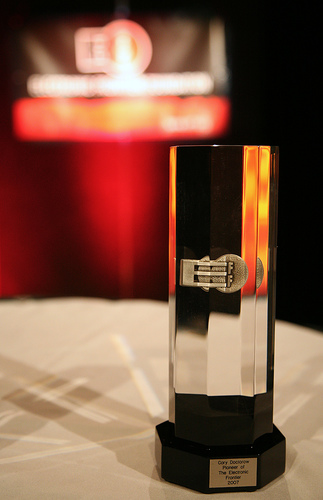
Congratulations to Dr. Michael Geist, 3rd Canadian EFF Pioneer Award winner!


While this is a picture of Cory Doctorow's award, one like it is coming to Dr. Michael Geist, Canada's third such award winner!!!!

The Electronic Freedom Foundation's motto certainly epitomizes the words and deeds of this inspired Canadian "Defending Freedom in the Digital Age." He has caused many to know their freedoms in the digital age, reminding them of their rights, and in the ardent defence of them, inspires many to remember what freedom is and of the necessary fights to preserve it lawfully.

Congratulations and thank you
Dr. Michael Geist.

Lawrence
PS Stephanie Perrin apears to be the first Canadian to achieve this honour. And DOH! Cory Doctorow number 2! Of course being a Canadian is a not exactly something too boasty but I did try to find out if Michael was the first.

Update: The EFF has replied to my query confirming Stephanie Perrin was the first Canadian winner.

"for her her instrumental and long-term role in advancing understanding and protection of privacy internationally and in her home country of Canada."


(CC) Photo by Scott Beale @ laughingsquid.com.

Tuesday, February 19, 2008

Access Copyright Board of Directors' Report: Part 3: the Most Egregious Finding

Professor Friedland, who was hired by Access Copyright ‘to undertake a full review of the distribution policy and methodology currently in practice at Access Copyright,' is far from an ordinary person to conduct this work.

Some have dismissed his work as just another consultant, just another lawyer. For those, I dare the reading of this link.

To the 20 recommendations he made in his report, the last one for a new composition to the Board itself to provide for independent Directors appeared quietly stated yet very wise, and has created what has to be a case study for what I would call a time paradox. The recommendation to add these independent Directors was not accepted by the membership of this organization, as implied by the actions of the Board, causing further evidence to come forth justifying the very recommendation.

This makes the actions of the Board here egregious to an observer that can use this episode as a case study of what not to do when you are on a Board and you have an outside consultant challenge your Boards’ composition, recommending independent Directors.

For a small corporation run for profit, it would be easy to reject this. For public corporations it is no longer a choice. For a private corporation, operated on a not-for-profit basis, with significant trust extended to it by the government of Canada, it presents an ethical challenge, that itself cannot be addressed logically without taking some significant steps.

From my perch at Northworthy where we aspire to the higher grounds, I would have to call this egregious conduct. There is no other word that comes to me that would attach to the sin of commission here. For a Board to make this decision itself, it appears to be a Board with greater control over its membership than it ought to have.

To justify it, to tightly control the message on it and to reject it, to refer the matter to and receive a recommendation from a subcommittee of the same Board, lacking independent Directors, this has obvious reek. When an independent consultant comes in and says something is wrong with your Board, it appears that this is the time to bring in specialists for a second opinion, and put it to the membership, if indeed you do not have independent Directors for this type of matter. This is the dilemma that Professor Friedland presented: what does a Board do if it does not have any independent Directors, and someone it hired says it should have had them in the past to prevent the otherwise accepted and acknowledged problems found from reoccurring?

Why did Professor Friedland venture into this subject area?

To argue the governance of the organization is beyond the fact finder's scope, is not realistic in that the Board’s decisions made on distribution policy and the rules incorporating them, in the past lead to the hiring of this independent fact finder. This was the Board itself that had approved the cumulative policy decisions known as its distribution rules that were found sufficiently problematic by its membership to hire this person.

Professor Friedland stated frankly at recommendation 20:

"Although the governing structure may not be directly within my terms of reference, I believe its structure has contributed to the present problems."
My emphasis above is on his use of the words “may not” and "I believe."

I believe he was being very political here in his choice of the term “may not” that could lead to a doubt arising to this question of task, knowing that this recommendation would not be readily appreciated. The discussion of the draft report for about one month prior to its finalization may have lead to this defensively stated but otherwise strong and sound recommendation in our opinion. To my analysis, the policy choices and how they are made could not be excluded by the express mandate he was given; to just look at the methodology, he would appear a unaware vassal instead of one highly proficient in all of his work.

Here is a problem. Here is the cause of it. Here is how to fix it.
Read em and Weap!


To the issue he raises, independent board members can provide greater assurance to all members, and members seeking to join, using a not-for-profit framework of analysis. They can also give a greater assurance to those who listen to their demands for tariffs and changes in laws to their benefit, giving greater credence to the conveyed public interest in taking such actions.

We remind in the public corporation sphere, there is no longer a question of the value of the independent Director: they are mandatory (Ed. Note: issues also arise as to social responsibility). So much so there is a Chartered Board of Director designation available for such purposes.

Lessons to Learn

Other non-governmental member organizations, operated on a not for profit basis, dependent on statutory laws passed by the government for their existence, might want to consider the Friedland report's recommendations and its discoveries, as a case study for their own governance. We can only guess as 'likely' what would have been found previously had there been independent board members, with no specific membership interests to consider above the whole of the membership. The publisher-creator even split into two equal groups with competing interests, on this Board, invites rather divergent debates and cabal like behaviours, without the necessary consideration of the other group’ interest. Worse, it may play to those known interests. Likely there were times after meetings, where each group met separately, overjoyed for what it thought it got away with on the other group.

The impact of independent Directors on this apparent conflict, to work for both interests, and what that impact may have been, is conjectural. It is however likely that some of the actions the Board took in 2007 from the Friedland report would have been accomplished sooner. Further, the more difficult areas that ought to have received prior recognition may have been subjected to earlier scrutiny, and the benefits of any such actions, would likely have been in the hands of the membership sooner. One can think of the cost savings too from not needing such an independent report with the now known suspicions to cause its commissioning, addressable by independent Directors.

Public Impact: What Does the K-12 Issue Really Say?

As to public impact, it appears quite apparent that the tariff put forth by Access Copyright for the K-12 educational group should have been made exempt by Canada on the basis of "national treatment." If Canada provides a benefit to its nationals, we cannot discriminate to deny that benefit to non-nationals who are treaty partners (see subsection 73(2) of the Copyright Act). When a large international discriminator is known to specialists in this area, the options and impacts ought to be considered. The misspent advocacy for tariffs omitting consideration of this lack of a reciprocal benefit to domestic copyright holders (if in fact Access Copyright does unfairly compensate the US holders who do not provide a similar benefit to Canadian holders), is just the type of matter than an independent Board member would put full consideration to, we would hope. By not letting this pass, in greater benefits to the foreign partners of the publishers, for small domestic gains to the writers, if any, the higher ground available to obtain in this type of matter would have been an option.

As is, the government and the Copyright Board of Canada may have questions to ask in this matter from the chief protagonist here, in the future. Instead of authorizing tariffs on internationally non reciprocal royalties, could we not have had higher tariffs on items subject to reciprocal royalties, without the unfair gains of the foreign controlled publishers apparent?

Surrendering such higher ground is not something an independent Director would likely do in any endeavour, behind otherwise the cloak of a private not-for-profit company. Revealing a possible low ground taken, and the losses to Canada unnecessarily on service royalties here, just cannot be in the long term interests of any actor in the Canadian copyright sector.

A legitimate question to ask: what if the same money was collected by Access Copyright but instead of the 31% of revenues from the K-12 sector, it got $0, in parallel to the United States, our largest trade partner, and obtained revenues from other sources equally? The outflows to foreign interests without reciprocal compensation, is stopped. The writers would appear to lose nothing from this, at worse, and potentially gain but the publishers of all stripes appear on first examination, to keep more, right in Canada.

An excerpt from the 2006 Annual Report of Access Copyright, with a final question, asked before the quote from Page 7 (two can play at that game!): to whom is any of this fair?

Copyright Board Filing

In 2006 we completed the school study that was initiated in March of 2004, when Access Copyright filed an application with the Copyright Board of Canada asking the board to determine the value of our Pan Canadian Licence Agreement with K-12 schools. In order to determine the value of the licence, the Copyright Board requires information on both what is being copied in schools, and the volume of that copying. Through the school study, which took place between February 2005 and March 2006, data was collected on more than 10 billion pages of materials that had been photocopied in schools across Canada. Analysis of those pages was completed in late 2006 and the final data was filed with the Copyright Board in November. The Copyright Board hearing will take place in 2007 and we are confident that the data collected through the school study will lead to a decision that is fair to both copyright owners and licensees.

Monday, February 18, 2008

Access Copyright Board of Director's Report: Part 2, The Findings of the Fact Finder

Professor Friedland (incredible credentials) prepared a report for the Access Copyright collective, that was finalized February 15, 2007. The Board of Directors considered that report and its 20 recommendations. On February 15, 2008, a version of the Board's report was made public, with redactions, pre and post statements to the included Friedland report. The Friedland report itself was revealed with many interjections and comments, potentially distorting its message v. being read on its own.

To this, we were not pleased in having to read this report with these comments combining with the lack of pagination and DRM in the published document, making fair use of this document difficult. For example, the report could not be overtly printed.

To this mixed pleasure, its rare for a private organization to reveal its warts and difficulties in such an open manner. In 2008, post-Enron, this is also the "nice" thing to do and they should be applauded here, in sharing how they themselves see these problems and how they have chosen to fix them, for anyone to second guess to their wits end (a Blog of this may be a wits end!).

Lack of Reciprocity in International Royalty Disbursements: K-12 Group

12% of the revenues gathered by the equivalent US organization, the Copyright Clearinghouse Center, "CCC", are from educational uses, excluding the K-12 group. Access Copyright's Board Report says 77% of the collective's royalty collections in 2005 are from educational uses, with no such exclusion (31% K-12). The fact finder says the US has an educational exemption that we do not have.

A fair question to ask is why does this collective pay the US apparently for this use in Canada, but it does not collect from them for this use in the United States? Are there reciprocal national treatment rights here in the Copyright Act, and if not, should there be an amendment for this, or should the similar exemption of the K-12 sector provided in US law be accomplished here, to balance against the US situation?

Creation of Creator/Publisher Splits ex of Foreign Rights Distributions: the Subpublisher Problem

Effect of Contract Overrides and Prof Friedland

The fact finder, as Prof Friedland is referred to, with no audit trail to follow and a great many assumptions, concludes on what creators may get directly and from publishers indirectly at 40% and the publishers net of these indirect payments at 60%, of the domestic royalties paid. This is stated at page 29 of the Board's report, per the PDF readers' identification (there is no pagination in the fact finders report section of the document).

To Truer Splits: Beyond Friedland

This is clearly a difficult area, as there are foreign subpublishers who may pay domestic publishers monies subject to contract overrides, from their receipts of the foreign reproductive rights organization (RRO), that ultimately is paid to the Canadian creator and publisher. 5% is stated as direct money received by Access Copyright from the RRO's in the overall royalties collected. What else is then received by domestic publishers and creators from this source was otherwise unknown, to date.

However in the opposite direction, from the fact finder discoveries, was that the domestic publisher acting as a subpublisher for a foreign parent, paid amounts to US publishers that exceeded the amounts that Access Copyright paid directly to the US RRO, the CCC, directly. The CCC is indicated as getting 60% of the RRO's payments from Access Copyright, $3.4 million in 2005.

So US publishers and creators get directly via the CCC $3.4 million, and indirectly from their branch plant publishers, "at least" another $3.4 million.

The potential "split," supplementing Prof. Friedlands' calculations on indirect payments:

  • Canadian creators, direct and indirect royalties: at least $5.9 million
  • Domestic publishers, minus indirect royalties paid: "at most" $5.6 million
  • US publishers and creators: more than $6.8 million
  • UK and other country publishers indirectly: ?
  • Other direct RRO's: $2.3 million
What About Indirect Royalties Received by Domestic Publishers, outside the Collective? Beyond Friedland Again

On the foreign payments and receipts, foreign sources are only 5% of royalty revenues, approximately $1.5 million (from $30 million a year in royalties and interest collected). They get at least $9.1 million, 6 times as much as they provide directly, or just about 50% more than the Canadian creator directly and indirectly.

In the related goods that would be subject to reprographic use royalty examinations, Canada imported $2,570,215,000 in books, newspapers and periodicals, in 2005. We exported $609,957,000 according to Statistics Canada, for a trade deficit of such goods at almost $2 Billion (1,960,258,000). Taking the "at least" figure of what is exported indirectly in royalties that was disclosed by the fact finder, less than 1/4 of that would be expected in return from foreign subpublishers from their RRO's receipts using the goods trade as a proxy (for the publication sub licenses including the right to print plus the physical goods).

Estimating those indirect royalties received at around $1,000,000 (if "only" $4,000,000 is paid from Canada indirectly, a figure we 'feel' as low due to the high foreign ownership we suspect but have not recently researched), this additional amount would be available to domestic publishers, for distribution to creators and for their own account, outside the flows from the collective.

Including these indirect royalties received assuming the same 18.8% pass-through to creators, as used by the fact finder:
  • Canadian creators: $6.1 million
  • Domestic publishers: at most $6.4 million (less "Y" + less ("X" - "more than" $3.4 m))
  • US publishers and creators: more than $6.8 million
  • UK and other country publishers indirectly: "Y"
  • Other direct RRO's: $2.3 million

What if the Publishers were 80% Controlled by Foreign Publishers?

With only 2/3 of revenues distributed, it also means that only a bit more than 1/2 of that is paid to domestic publishers and creators, directly and indirectly. The domestic publishers get to keep much less than the Canadian creators in our analysis from reprographic royalties when factoring in the expected indirect payment and receipt flows, that should be occurring outside the scope of the collective (domestic subpublishers to all foreign publishers, foreign subpublishers to all domestic publishers). This may explain some reticence on changing anything to favour the creator group inside the collective, in spite of what may appear as distributional disparities against the creators within the collective (this is read as a battle lost in the Board Report).

The payments potentially outside the scope of the collective, that Prof Friedland only starts into discovery, appear to make domestic publishers, foreign controlled or not, rather a "grisly" bunch relative to the domestic creator class on closer examination over the spoils here.

If Canada's publishing industry is as dominated by foreign ownership as we suspect but don't know (not in the mind at this time but I am sure I read it somewhere ...), and if a very large share of the royalties collected by domestic publishers are subpublishing in nature and going to foreign parent publishers indirectly (the RRO payments would be independent of any domestic publishing relationship), the Canadian creators clearly would retain much more money than the domestic publishers here.

Example of 80% foreign ownership level with subpublisher agreements between subsidiary and parent publisher:
  • Canadian creators: $6.1 million
  • Canadian controlled publishers: $2.6 million
  • Foreign publishers and creators: $7.3 million
  • Other direct RRO's: $5.7 million
This foreign ownership factor skews the calculations significantly (removing the "more than" and eliminating "UK and others" to be subsumed with "foreign"). It also pushes to mind how much in fact the domestically controlled industry including creators actually get from the $30 million collected on their behalf. The system is benefiting the writer class here but for every dollar they are paid, more than $2 go out of the country. The Canadian controlled publishers meantime are hurting by this system. Less than 9% of what is collected goes to them. The writers who appear to complain plenty, are at least getting 20% of all collected, well double what their domestic publishers are getting from this system.

This dimension of course adds to the mystique on one very interesting recommendation the Board of Access Copyright rejected: the Independent Directors as recommended by the fact finder.

Part 3, the Most Egregious Finding IMHO

Saturday, February 16, 2008

Access Copyright Board of Director's Report: Part 1, Its Hard to Get to the Beef!

On occasion Dr. Michael Geist gets a report of a report and posts the information up in advance of the report being publicly available. Snippets of content are posted and then inevitable the evidence arrives.

With baited delight, I come back later, to whisk over to the new hyperlink to obtain the report, in this case downloading directly from the Access Copyright site (this is called "bandwidth stealing," Dr. Geist!).

Seeing the report download before "I" pop it open (I do this with PDF files), I open a tab and go over to the Access Copyright.ca website and hunt down the public report.

Before doing so I read their terms of service (TOS) and privacy statements, as those have become of interest lately (I was using the free plugin for Firefox, the Canadian Collaborative Privacy Protection and Accountability toolbar for a while, to automatically scan for the Privacy information from any website: an interesting exercise itself).

In Access Copyright's case, they appear to have a TOS that in a word is complex. Why so complex?

They give rights then they take them away, condition what they take away, then make various offers of grant, then go into UPPERCASE typing ... any UPPERCASE typing I have seen is impolite on the Internet (clue time), and is an indicator of "older" legal advice that in the norm of public behavior on the Internet is to be classified both "Ignorant" and "Rude" at the same time. Every EULA that uses BOLD typefaces, is très gauche. Even MS limits its use to what it must specifically repeat on instructions of its licensors. Its wised up.

So Strike 1. UPPERCASE

What you can do with the content: Authorized and limited licence
Access Copyright grants you a royalty-free, non-exclusive and non-transferable licence to view and display the Content on your computer, and to download and print all or any part of the Content. Unless you have a separate written agreement with Access Copyright that permits further uses, you may only use the Content for personal or educational purposes.
Copyright (c) 2007 ACCESS COPYRIGHT

http://www.accesscopyright.ca/Default.aspx?id=120
Nice, simply stated at first glance, but the following 728 words before "Links to Other Websites"?

What does this actually imply, like I need this permission, and if its not stated, I do not have it otherwise? Huh?

I do not have otherwise the right to view your site on the public portion of the Internet? Display its content (ephemeral copy in RAM), and to download (permanent copy of a public website and any of its content) and print anything of what I see?

Strike 2. For requiring EULAYZER to take a peak at your "licence" and making this an issue.

Socan, the copyright collective the fact finder pointed to as a positive model, uses 696 words for its entire TOS; Access Copyright's is 1349 words.

Next pitch ...

This one get the apoplectic award and strike 3: the report of Access Copyright's Board of Directors on the report of the Fact Finder, Professor Friedland, is DRM'd so that you cannot print it, you cannot copy from it, you cannot comment on it, you cannot well do much with it but read it. No fair dealing here at all or fair use readily.

In a sense, this Content appears to violate the grant to me, that I do not think I need. Of course somewhere in the 728 words following its likely excused, but it all seems so unnecessary.

There is a lot there to talk about here, and I hope it gets talked about at a public inquiry, not a committee. Why not a committee? A committee won't get it, but an inquiry would, and would not let go of certain issues, like ...

In Part 2.

Tuesday, February 12, 2008

Bits and Bytes 1

In the travels of late, I have come across things that deserve some mention.

Item: The Canadian Library Association has asked its 2,366 members in its constituent groups, to put forth advocacy at this time to the politicians. It claims to represent on copyright reform the perceived best interests of its professional librarians and their 21 million library patrons.

  • Canadian Association for School Libraries (CASL), including the School Library Administrators' (SLAS) section (approx. 225 members)
  • Canadian Association of College and University Libraries (CACUL), including the Community and Technical College (CTCL) section (approx. 775 members)
  • Canadian Association of Public Libraries (CAPL), including the Canadian Association of Childrens' Librarians (CACL) section (approx. 630 members)
  • Canadian Association of Special Libraries and Information Services (CASLIS), with chapters in Calgary, Edmonton, Manitoba, Ottawa, Toronto and Atlantic Canada (appro. 585 members)
  • Canadian Library Trustees Association (approx. 170 members)
Some reform concerns (with my thoughts added afterwards in red):
  • punishes copyright-infringing behaviour, but does not ban devices that might be used to circumvent technological prevention measures for legal purposes => what about research on TPM's?
  • government documents and government data belong to all Canadians and that all Canadians should have access to these materials => Kill crown copyright?
  • Persons with perceptual disabilities must have the same right to access copyrighted materials as all Canadians
    • This right should apply regardless of format in order to accommodate their particular needs => need to break the TPM to conform to known solutions, unserviced by "professional publishers"?
  • Libraries oppose legislation that repeats the same mistakes as the American Digital Millennium Copyright Act. American law does not adequately differentiate in penalties between a counterfeiter circumventing technical protection measures for illegal profit and an individual circumventing technical protection measures to make a single legal copy.
More on their position and kit is here.

Item: I am seeing too often the claim that P2P is taking up 95% of the bandwidth on the Internet. Something appears wrong with that. P2P also includes Skype (2%). Some studies seem to indicate 65% of the bytes downloaded are P2P files. Most studies seem to indicate that HTTP webpage requests, including VPN's, are still actually dominant in terms of traffic flows. More on this to come: I like reading network engineering studies.

Item: Interesting charts here on how small the North American Internet Market is becoming, by users, at just 18% in relation to the world. According to InternetWorldStats, at December 31, 2007, there were 1,319,872,109 users. Canada ranked 14th in broadband penetration and the US 19th based on varied sources of data and periods. Bermuda is #1.

Item: I saw Minister Josée Verner on CPAC at the Status of Women Committee the other day, and I confess I have never seen a Minister read so much from their briefing book. She looked terrible reading answers to questions, with the answers at times apparently from the wrong page. Très inconfortable. Even the "slow pitch" questioners from the same political party, appeared visibly to show disdain, disgust, impatience, and/or disappointment in their faces with this Minister, demonstrating that there may be a larger issue here with this appointment (she could have had an off day too). The questioning seemed to become "merciful" near the end, but for several MP's that wanted their concerns responded to with the unscripted thoughts of the Minister. A hotter issue of how this Department represented Canada overseas with out of date publications arose. No script for that. I cannot see her reappointed here and understand why Minister Jim Prentice is taking the lead on Copyright reform in this Parliament. Her confidence appeared shot both personally, and with her own members. I think all the members wished it was just stonewalling. For "real" TV it was a sad performance to watch. Thankfully I picked it up half way through where it became interesting to see a Minister read all their replies. Is that what her more than $242,000 salary per annum gets us?

We Will Never Know What the Tories Were Going to Do on Copyright

Howard Knopf has a good post on what the Industry Minister said in Calgary that may have been over the line on what signing a treaty actually obliges a country to do.

While Howard also says that there is some debate over what constitutes a minimal level, he did say that the maximalist demands are not in Canada's interest.

I wish for everyone paying attention at the moment, that the Conservatives Bill was put to first reading (sharing this opinion with Russell McOrmand). We do not know really what the Conservative's view is in proposed law and without that, it cannot be differentiated well from the Liberal's prior views in their bill. The Liberals in a minority parliament at least had the guts to present a bill, that was widely panned. The nouveau Tories cum Reformers? They are playing poker with us at the moment.

The election game strategy is on in Ottawa and one bill hanging in the balance is the Act to Reform the Copyright Act, lately seen as an untabled "Bill C-2" on the current agenda. If there was a book on this, I would bet that Act is now tied up in election strategies, and this Bill is highly unlikely of ever being seen, in the House, or elsewhere.

It leaves a mysterious abyss, on what the Conservatives' were actually going to do in light of their stated "promises" and by removing the issue from an election, ensures that the Fair Copyright for Canada Facebook group does not get any extra energy with "just" 40,000 members to date. With the wrong words in any reforming Act, that group could double or triple and who knows where it could stop. Simply, no bright minded minority government would risk this. And they do seem to know of the Facebook group, thanks to those pesky Calgary members who braced a white out, to again see Minister Prentice and ask questions [Kempton Lam, Fair Copyright for Canada, "Order of Fair Copyright" Medalist Northworthy Nominee!].

The Conservatives are supposed to be bright but watching the House of Commons debates today, that brightness may be a perceptual overstatement. The bottom line for a minority government is that it must govern, and the House is far too ornery on both sides for it to get any real work done. If there is no work, its election time [Did Harper eat too much on holidays? Will he colour his hair, again? Has Dion gotten taller, and a new barber? Has he gotten English elocution lessons so the ROC can understand what he is saying?]

All I can say is, pity the new bureaucrats who were close to closing this file for the government, with the latest unknown spin, after the Minister of Industry took charge of the file from the Canadian Heritage Minister. Who knows, in a Liberal minority government, will it go back to the Canadian Heritage Minister?

This is tough too on the lobbyists (big tears), to know where to send their people and money to help elect the right folks. For them, especially the known foreign interests, this will be a very interesting Web 2.0 election, with 40,000 Facebooker's well able to do the digging to find out what they do, and who they support, probably at about the same time as they do.

Update: Michael Geist's sources indicate the imminent arrival of the "Business Coalition for Balanced Copyright" - a who's who in Canadian Business (including some foreign controlled entities). If this is not a mirage, this is just another reason why we can expect the use of an election for the Tories to escape saying a "Canadian DMCA" is their plan in legislation. Certainly not before an election with this kind of opposition, and if that is their plan, they should make it public as part of their election campaign, squarely. After this development, I personally cannot see a chance of this bill hitting the house now till after the Budget, if this House makes it that far.

Update 2: No mirage. A storm is a brewing as more members have come forward than indicated in its original title. The full document titled "The Balanced Copyright Coalition is a coalition of telecommunications, broadcasting, Internet, technology, research and security organizations interested in the development of Canada’s Copyright Act" has morphed into including the Retail Council of Canada, and who knows who else, when the group goes "Gold" in public. Google also has a blog on this group and what it wants.

The list of members at February 12, 2008:

Canadian Association of Broadcasters (CAB)
Canadian Association of Internet Providers, a division of CATAlliance (CAIP)
Canadian Cable Systems Alliance (CCSA)
Canadian Wireless and Telecommunications Association (CWTA)
Computer and Communications Industry Association (CCIA)
Retail Council of Canada (RCC)
Google
Third Brigade
Tucows
Yahoo! Canada
Cogeco Cable
EastLink
MTS Allstream
Rogers Communications Inc.
SaskTel
TELUS